
Bishnu Pokharel
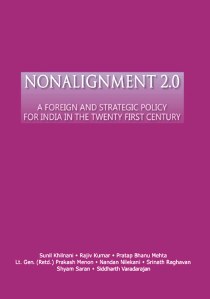 When readers get some book to read, they start cultivating own idea in their mind about the book they have. After analyzing the title of book readers start assuming the content of whole book, doesn’t matter whether it’s true or not.
When I got a report titled Nonalignment 2.0 published by Centre for Policy Research, India, I also didn’t forget to make assumption on whole report as other readers do. Before going through this report, I had a different perception about it, I was thinking the report would deal with neutral and liberal idea of ‘Nonalignment’ and ‘Panchaseel’ but I found the theme entirely different when I got into it.
The self proclaimed ‘A foreign and strategic policy for India in the 21st century’ documented by Sunil Khilnani, Rajiv Kumar, Pratap Bhanu Mehta, Prakash Menon, Nandan Nilekani, Srinath Raghavan, Shyam Saran and Siddharth Varadarajan is not liberal, neutral and non-aligned school of thought.
In spite of having the title ‘Nonalignment 2.0’ it suggests Indian state to follow deep realistic views of international relation in renovated forms, it is neo-Chanakyain or neo-Thucydidesian doctrine and there is no modern liberal thoughts, I must say. It focuses only on Indian establishment by using all sorts of powers not only liberal and soft also hard power.
This is the first document, which came as an independent work done by experts group, in this regard it is very good initiation. But the theme of report couldn’t even justify the title. This document suggests restricting economic presence of China in Indian land in this globalised age by giving the reason that China may have political interest to enter in Indian market as an economic player (Paragraph 35 & 36). Many Indians believe that this is very genuine concern over China, but if these exports are forming the policy for 21st century, they have to look into international scenario too.
This document prescribes Indian state to be strong enough to fight front war with China and Pakistan rather than establishing good relation with these two neighbouring states. Reader can feel the sense of enmity in many places of the document, especially for China and Pakistan. Deeply rooted Indian paranoia over China and Pakistan can be seen very clearly in the mind of experts.
For instance, we can see the paragraph 55 for knowing the generalised thinking over Pakistan and hostile mindset for that country. This paragraph says; ‘The Pakistani establishment-including the Army, the ISI, and the bureaucratic and political elite-believes that it is only cross-border terrorism that compels India to engage with Pakistan and accommodate its interests. There may differences of emphasis, but there is no fundamental gap in the perception and attitudes among different sections of the Pakistani elite.’ Furthermore; in paragraph 57 they stated, cross-border terrorism is the Pakistan’s state policy and India should seek help form US to control it. It is very unacceptable act to interpret the state’s policy of Pakistan as cross-border terrorism, and they have confirmed it without any proof and valid references.
This document suggests that, for countering Pakistan on Jammu & Kashmir issue; India has to pick the issues of Balochistan and other states too. I wonder, how so called non-alignment thinking suggests interfering other’s internal issues. In paragraph 67 it denies the special role of Pakistan in Afghanistan but praised the role of India. This is also another hypocrisy and hegemonic idea of India coined by these experts.
Though, the title of this report is ‘Non-alignment’ but the document has its focus on military strength and Realpolitik solution with China and Pakistan. It suggests to Indian state to conduct guerrilla warfare with China to get disputed territory back, (Paragraph 175) rather than seeking political and diplomatic solutions. It should have suggested political and diplomatic solutions for tackling and solving issues related to conflict with china and Pakistan.
This document seeks strategic autonomy of India like Nehru did immediately after independence and he succeed in some extent. Many scholars claimed that Nehruvian ‘Non-alignment’ was a strategy not a doctrine, that’s why India got closer with Soviet Union during cold war. Some believe that, Nehruvian ‘Non-alignment’ lost its credibility as India had close tie-up with Soviet Union. But this document is dealing with multi-polar world, not like Nehruvian age of bipolar world.
In this era new media itself a power and the cyber security became very important in every county. This document recommends many ideas to deal with cyber security and utilize the cyber space for Indian national interest. This is a positive strength of paper. It suggests India, how to get benefits by knowledge business and soft powers. It may be the first Indian document to deal with some new international phenomena and give advice to government. In this sense this is very good reference for policy formation.
This document contradicts itself in some places like dealing about internal conflict such as Naxalism. It describes Naxalism as a political and social problem due to injustice and social discriminations and again gives the advice of getting solution by police actions. Not only that, it suggests the formation of citizen vigilance groups with weapons to counter Naxal movements. Here the question arises, if it is really a political problem than why the military action is needed? It may harm Indian national interest in international level. If deep human right violence happened like Sri Lanka, how India would save its face in front of international community?
As writers claimed; this document can be the guide for India to form international policy for next decade, but it cannot fulfil the general idea of ‘Non-alignment’. It can be a very realistic Indian establishment guide for this decade but not a blueprint of ‘Non-alignment’.
 Voice of South Asia