Guide for Realpolitik and Indian Establishment

Bishnu Pokharel

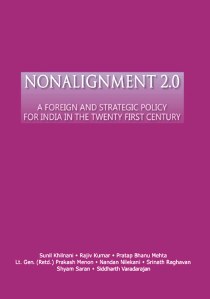
non-alignment-2When readers get some book to read, they start cultivating own idea in their mind about the book they have. After analyzing the title of book readers start assuming the content of whole book, doesn’t matter whether it’s true or not.

When I got a report titled Nonalignment 2.0 published by Centre for Policy Research, India, I also didn’t forget to make assumption on whole report as other readers do. Before going through this report, I had a different perception about it, I was thinking the report would deal with neutral and liberal idea of ‘Nonalignment’ and ‘Panchaseel’ but I found the theme entirely different when I got into it.

The self proclaimed ‘A foreign and strategic policy for India in the 21st century’ documented by Sunil Khilnani, Rajiv Kumar, Pratap Bhanu Mehta, Prakash Menon, Nandan Nilekani, Srinath Raghavan, Shyam Saran and Siddharth Varadarajan is not liberal, neutral and non-aligned school of thought.

In spite of having the title ‘Nonalignment 2.0’ it suggests Indian state to follow deep realistic views of international relation in renovated forms, it is neo-Chanakyain or neo-Thucydidesian doctrine and there is no modern liberal thoughts, I must say.  It focuses only on Indian establishment by using all sorts of powers not only liberal and soft also hard power. Continue reading “Guide for Realpolitik and Indian Establishment”
Slavery of violence or Freedom?

shadow-linesBishnu Pokharel

English Writer George Orwell used an ironical slogan in his novel- 1984, ‘War is peace. Freedom is slavery. Ignorance is strength.’

Exactly, freedom is slavery and so called freedom fighters are slaves of violence, inhumanity and madness. I don’t know is it appropriate or not in other sense, but idea of freedom in South Asian sub-continent is slavery of violence, inhumanity and madness.

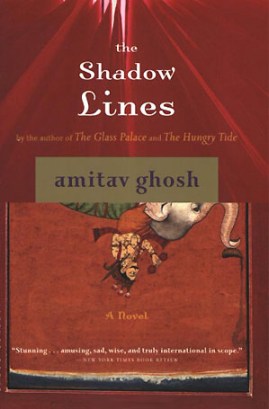
We South Asians think that freedom means impunity, absurdity, anarchy, immorality, inhumanity, clan politics and communal thinking. But, it’s not my argument; we can find that argument in three different forms of partition literature; Amitav Ghosh’s novel The Shadow Lines, Saadat Hassan Manto’s short story Toba Tek Singh and Faiz Ahmad Faiz’s poem The Dawn of Freedom.

These three great post-colonial literary works from South Asia show that the idea of freedom is contaminated with violence and communal mutiny and common people are suffering by that contaminated idea of freedom. According to these three different forms of literature; freedom means breaking brotherhood, divide mother’s heart and lapel into many pieces and draw lines between father and son, mother and daughter, brother and sister and even husband and wife.

In ‘The Shadow Lines’, after death of their grandparents Thamma’s family wanted to be free from each other and they divided in two families by drawing lines on the wall of their traditional house, like Line of Control between India and Pakistan post 1947. Two families started to behave with each other like enemies and that traditional faithful house became a “Ruin of Faith”. The idea of freedom broke brotherhood in family and created enemy under a roof. Writer tries to show that how did Indian people lose their brotherhood in partition time through the situation of that traditional house. Family members got freedom but they lost their brotherhood, faith, trust, collective happiness, love and unity. Same thing happened in India after independence.

Continue reading “Slavery of violence or Freedom?”

Absence of SAARC in Disaster Management

Bishnu Pokharel

April 25, 2015 catastrophic wave occurred in Himalayas of South Asia. The epicentre was some 80 kilometers away from Kathmandu, capital city of Nepal. After eight decades, earthquake with the magnitude of 7.6 shaken Nepal and claimed the life of 10 thousand people and rendered thousands of people homeless. Most of the countries of this sub-continent including Tibet have also experienced same super-wave.

Even though, existence of many borders, boundaries, restrictions, official procedures, barriers and blocking, nobody could control that super natural wave to enter their territory.

The wave occurred with the epicentre Barapak village of Gorkha Nepal and it was felt at Bay of Bengal in South and Tibet in North. Even Mount Everest couldn’t be the exception of this tremor. The powerful and devastating wave came from deep of earth and didn’t take even single minute to destroy millions of infrastructures and thousands of human life. When that supra-natural wave occurred, all political boundaries have been collapsed. It didn’t care about strict visa and immigration rules. The interesting thing is that nobody dares to question the wave; though it had broken these immigration rules!

Comparing to Nepal, there has been less damaged of infrastructure and human life in India, Bangladesh and Tibet. But nobody deny that wave has crossed their strict borders and didn’t follow the ‘so called’ rules and regulations. These are very necessary for human beings when they try to cross any border.

When wave was moving from its epic centre, nobody demanded passport or visa with it! Everyone forgot about their strategic importance, diplomacy, core national interests and race of superpower. First, all states had started to think about their own people and infrastructure. When they realized that, there was not that much loss in their side, they started to think about others.

The small landlocked Himalayan nation Nepal has been massively affected by earthquake. Many countries urged for relief and assistance including neighbouring India, Pakistan and China. Assistance and relief activities started at Nepal, and everyone has taken it as pure humanitarian help. But some countries started conspiracy, competition and attempt to control sovereignty in the name of relief.

One may think, this is nothing more than jingoism and xenophobic paranoia, but certainly not. The debate on rescue and relief had been going along with issue of assistance and relief diplomacy at that time. Some international media analysed these incidents as ‘relief and rescue cold war’. Continue reading “Absence of SAARC in Disaster Management”

Political Shadow on Economic Cooperation

Bishnu Pokharel

Institutionalised initiations of integration are new phenomena in the realm of international relations. History of liberal and institutionalise integration initiation goes back to the establishment of League of Nations. That initiation couldn’t survive and unable to stop second holocaust but left strong footprints to follow. Immediately after the Second World War, United Nations (UN) followed these footprints and became successful up to some extent.

Beside the global integration effort like UN, some European countries started different cooperation movement. It began with European Coal and Steel Community (ECSC), matured as European Community (EC) and eventually turned into European Union (EU).

Most of the scholars from social science discipline agreed that UNO is the first successful global supra-national organisation. These scholars accepted that EU is the first successful regional organisation as well. Different histories can be found, when we go through the evolutionary process of both organisations, though background was the same. UN emerged as an international organisation to handle political issues and to maintain peace in post war period. And, ECSC has emerged to tackle with economic recession caused by long and expensive wars.

Today, the movement of regionalisation isn’t confined only in Europe, it spread in all continents. Though, EU, African Union (AU) and Association of South East Asian Nations (ASEAN) are dealing with political problems and negotiations; but they came together for economic cooperation. The primary focus of ECSC and EC was ‘economic cooperation’ and ‘regional trade integration’. But with the passage of time they added political cooperation too.

Germany and France had fought long war between each other till World War II. Traditionally they were enemy, but after the holocaust they came together to coup with economic recession by taking the initiation of establishment of the ECSC. Now, they are together even in military alliance like North Atlantic Treaty Organisation (NATO).  

The tie up between France and Germany can be seen as a motivating example for explaining the role of economic cooperation to change the relation from enmity to amity. If we minutely study about the evolution of regional integration, we can find crucial role of economic cooperation to build confidence between hostile nations.

The definition of power and diplomacy has been changed. Realistic view of power and diplomacy is not suitable in this globalise and liberal world. Diplomacy based on politics and military power is not much important now. Political diplomacy is becoming as a shadow of economic diplomacy. For instance, we can examine relation between USA and China, Japan and China, China and India and also the Cuba’s relation with USA. Continue reading “Political Shadow on Economic Cooperation”

Why engaging students in integration is important ?

Bishnu Pokharel

Students are wealth and strength of the world. Future lies on their head and solder. They are going to be the future leader of every spares in society. Here, we are not going to talk about student’s role in every affair; certainly we talk about student’s role in regional integration. As our webpage suggests, we confine on South Asia and try to dig out certain perspectives on student engagement in integration process.

Without proper plan in present, future will not be bright. Today’s students are tomorrow’s leader that is why if we don’t engage them in future integration process, how come regional cooperation and integration will be possible? No doubt, today’s student engagement will help for integration in future.

South Asia is facing varieties of complex problems among neighbours, mostly driven by political disagreements, disputes and distrusts. There is no ray of hope for political cooperation like European Union (EU) yet. It remained as a romantic reverie, which doesn’t have immediate sign to be turn into reality.

Continue reading “Why engaging students in integration is important ?”